

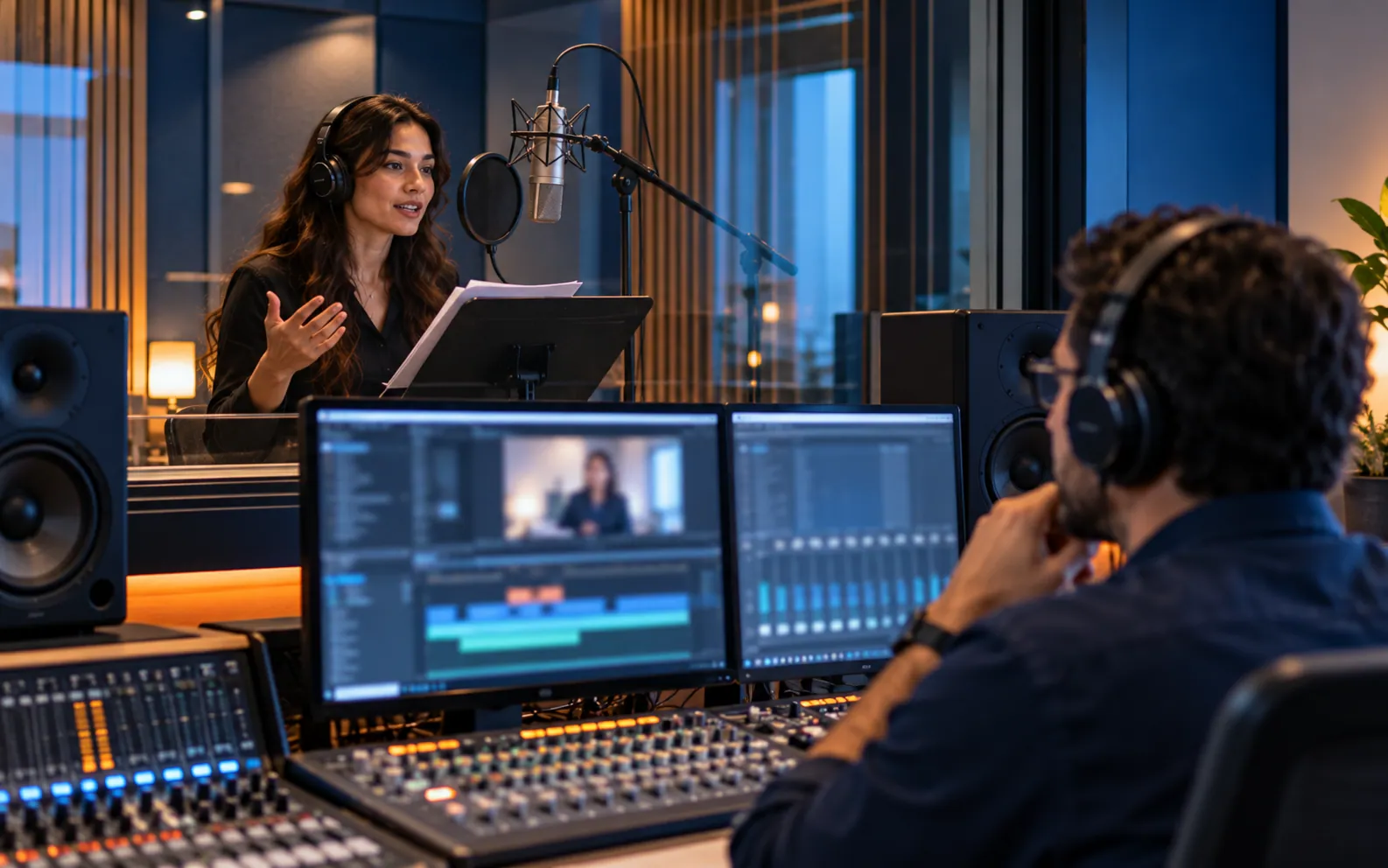
Taking video global means deciding how each audience will experience your content in its own language. Subtitles are the fastest and most economical route and keep the original voices; voiceover and dubbing overlay or replace the audio for viewers who would rather listen; and transcreation reshapes scripts, slogans and on-screen messages so they persuade in each culture. Most programs combine these methods by content type, starting from a clean, time-coded transcript.
Begin with a reliable transcript
Every multilingual video workflow depends on knowing exactly what is said and when. Transcription captures dialogue, speaker changes and meaningful sounds, while time codes anchor each line to the picture. That transcript becomes the source for subtitles, the starting script for voiceover and the brief for transcreation. Errors made at this stage multiply across every language, so a careful review of names, numbers and product terms pays off later. It also supports same-language captions for viewers who are deaf or hard of hearing.
Subtitling: fast, affordable and authentic
Subtitles render dialogue as timed text on screen while the original audio stays intact. Viewers hear the real voices and emotion, and costs stay relatively low because no studio recording is involved.
What good subtitles look like
Professional subtitles follow strict readability rules. Netflix's English timed text style guide, for example, allows 42 characters per line and two lines per subtitle, with reading speeds of up to 20 characters per second for adult programs and 17 for children's programs. Its general requirements also cap each subtitle event at seven seconds. Line breaks should fall at natural phrase boundaries, never between an article and its noun.
Subtitles, captions and SDH
- Subtitles translate spoken dialogue for viewers who can hear but do not understand the language.
- Closed captions transcribe dialogue and meaningful sounds in the same language, mainly for deaf and hard-of-hearing viewers.
- SDH (subtitles for the deaf and hard of hearing) add sound cues and speaker identification to subtitles, in the original language or a translated one.
Accessibility standards reinforce the value of text tracks. WCAG lists captions for prerecorded video as a Level A success criterion, and captions for live media and audio description for prerecorded video at Level AA. For television, FCC rules at 47 CFR 79.1 set caption quality standards for accuracy, synchronicity, completeness and placement, a useful benchmark for any caption file.
Voiceover and dubbing: when audiences prefer to listen
Audio replacement makes sense when viewers need their eyes on the action instead of on text, as in software demos, safety training, children's programming and content watched on the move.
Three common styles
- Narration: an off-screen voice replaces the original narrator; common in e-learning, explainers and documentaries.
- UN-style voiceover: the translated voice starts just after the original speaker, whose audio is lowered but still audible; common in interviews and news.
- Lip-sync dubbing: actors re-record dialogue to match mouth movements and timing; the most immersive and the most production-intensive option.
Scripts usually need adaptation before recording, because a translated line can run longer than the time available on screen. Casting matters as well, since age, energy and regional accent shape how the audience perceives the brand.
Synthetic voices and automated dubbing tools are improving and can suit internal or high-volume content. They still need a native linguist to check pronunciation of names and terms, pacing against the picture, and whether the emotional delivery fits the scene. For customer-facing campaigns, human voice talent remains the safer choice.
Transcreation: adapting the message, not only the words
Transcreation blends translation with copywriting. A tagline built on an English pun, a sports reference or a local holiday may mean nothing elsewhere. A transcreator starts from the brief, the target emotion and the call to action, then writes new copy that achieves the same effect. Deliverables typically include several options per line, back-translations into English and notes explaining the cultural reasoning, so marketing teams can choose with confidence. Transcreation also covers supers, end cards, thumbnails and other on-screen text that is easy to overlook.
Comparing your options
| Factor | Subtitling | Voiceover | Lip-sync dubbing | Transcreation |
|---|---|---|---|---|
| What changes | Text added on screen | Narration replaced or layered | All dialogue re-recorded to match lips | Script, slogans and on-screen copy rewritten |
| Viewer experience | Reads while hearing original voices | Listens; original may remain faintly audible | Fully native viewing | Message feels created locally |
| Relative cost | Lowest | Moderate | Highest | Varies with creative scope |
| Turnaround | Fastest | Moderate | Longest | Depends on review rounds |
| Best for | Social clips, interviews, films, internal updates | E-learning, explainers, product and corporate video | Entertainment, children's content, premium ads | Ads, campaigns, brand films, taglines |
Transcreation often pairs with one of the other three: the adapted script is then subtitled or recorded.
Matching method to content
- Social media clips: subtitles styled for small screens, with short lines and strong contrast.
- E-learning and training: narration so learners can follow on-screen steps, with subtitles as an option.
- Product demos and tutorials: voiceover plus a localized interface on screen where possible.
- Advertising: a transcreated script with voiceover or dubbing, plus localized supers and end cards.
- Webinars and executive messages: subtitles that keep the speaker's own voice and authority.
- Entertainment and children's content: dubbing where budgets allow, with subtitles as a secondary track.
Plan for on-screen text and graphics
Dialogue is only part of what viewers read. Lower thirds, callouts, charts, product labels and end cards all carry meaning, and leaving them in English undercuts an otherwise localized video. There are three common ways to handle them:
- Re-render graphics from editable project files, the cleanest result when source files are available.
- Add forced narratives, short subtitles that translate only on-screen text, when graphics cannot be changed.
- Design for localization in future productions by keeping text on separate layers and avoiding words baked into footage.
A production checklist for multilingual video
- Lock the edit before localization begins, because late picture changes ripple through every language.
- Share source assets: scripts, project files, music and effects tracks, and graphics with editable text layers.
- Provide a glossary and brand voice guide, including terms that must stay in English.
- Agree on deliverables, such as SRT or WebVTT files, burned-in versions or mixed audio stems.
- Plan a review step with in-market stakeholders before final export.
- Run final QC in the actual player or platform where viewers will watch.
How ZED Localization helps your video travel
ZED Localization's multimedia services cover transcription, subtitling, voiceover and transcreation in 50+ languages, coordinated by an in-house team that keeps terminology aligned with your website and print materials. Projects follow ISO-certified processes from transcript to final QC.
If the video is part of a wider launch, ZED can align it with website and product localization so every channel shares the same terms and tone. Share your files and target markets through the quotation form to receive a scoped plan.